
Tradify Review Australia 2026: Real Pricing, Pros & Cons for Tradies
Tradify is one of the two job management platforms most Australian tradies seriously consider. Whether it's the right call for your business comes down to one thing: how many staff you have. Most Tradify reviews skip past that. This one doesn't.
I've checked the pricing direct with Tradify, most recently on 4 November 2026, spoken to electricians and plumbers running it as their primary system, and tested the mobile app on both iOS and Android (on a Pixel 7).
Looking for a discount code? Tradify's EOFY 2026 code, AUEOFY26, expired on 30 June. My Tradify discount codes guide explains what is on offer now.
Want the pricing breakdown? See my standalone Tradify pricing breakdown for what Lite, Pro and Plus cost in real AUD by team size, including why Tradify's public page shows US dollars.
What Tradify actually is
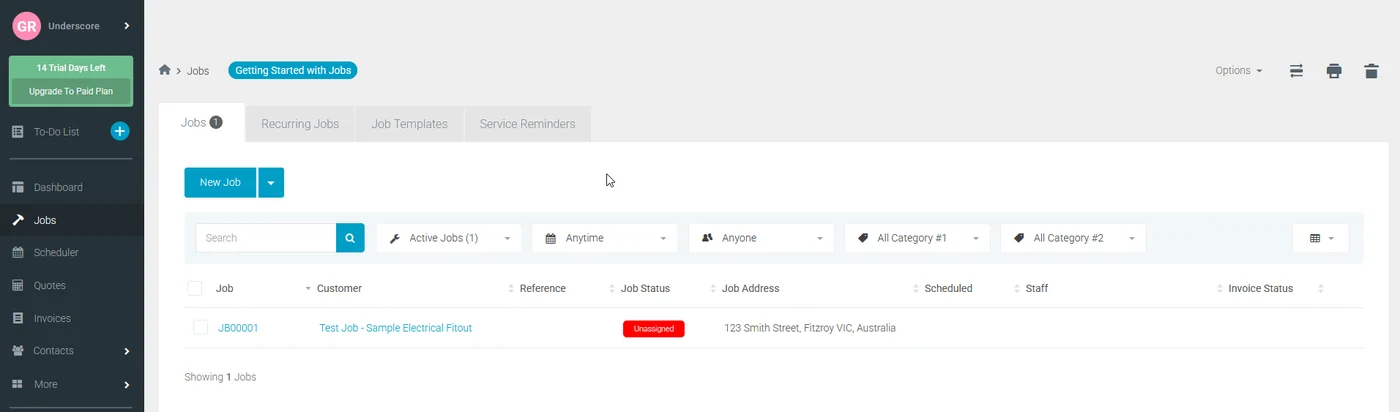
Tradify is a cloud-based job management platform for trade businesses. Electricians, plumbers, HVAC technicians, builders, gas fitters, property maintenance, and similar. It covers quoting, scheduling, timesheets, job tracking, invoicing, and accounting sync. Mobile apps for iOS and Android, plus a web dashboard for office work.
The product originated in New Zealand and is now part of the UK-based Access Group. The Australian customer base skews toward small electrical and plumbing businesses with 1 to 10 field staff. It integrates with Xero, MYOB and QuickBooks Online, and accepts card payments via Stripe.
The pitch: replace whiteboards, spreadsheets, and paper job cards with a single tool that runs the full job-to-invoice workflow.
Free Tool
How much will Tradify actually cost your team?
Tradify charges per user, every month. The cost ramps fast as you hire. See the realistic monthly figure for your team size before you commit.
Try the calculator →Tradify Australian pricing (November 2026)
Tradify prices in AUD per user per month, ex GST. This is the most important thing to understand about the product. Every staff member you add costs the full per-user rate, every month. There's no "office staff" lower tier and no shared-licence model.

| Plan | Price (AUD/user/month) | Best for |
|---|---|---|
| Lite | $48 | Sole traders or 1 to 3 user crews wanting the basics |
| Pro | $52 | Professional businesses wanting the full feature set |
| Plus | $62 | Larger teams, includes SmartTools (AI features) |
| Custom | Price on application | Large teams with specific needs (call 1800 955 260) |
Currency note, confirmed 4 November 2026. These AUD prices are still current. Tradify's Australian plan cards showed the same $48, $52 and $62 per user per month, ex GST, on 4 November 2026. The public page at tradifyhq.com shows a separate US dollar list (Lite $47, Pro $51, Plus $61) to every visitor, which is why you will see both sets quoted. See our Tradify pricing guide for the full breakdown.
Add-on costs to budget for: Instant Website at $12 a month; SMS quotes and invoices at 20c per message; SMS appointment, quote and payment reminders at 20c per message.
Real monthly cost examples (ex GST, before SMS or add-ons):
| Team size | Lite | Pro | Plus |
|---|---|---|---|
| 1 user | $48 | $52 | $62 |
| 3 users | $144 | $156 | $186 |
| 4 users | - | $208 | $248 |
| 6 users | - | $312 | $372 |
| 10 users | - | $520 | $620 |
A 14-day free trial includes all features. No credit card required to start.
What Tradify does well
The user experience is actually simple, which I don't say lightly about software in this category. Most tradies are quoting and invoicing within an hour or two of first opening it, without partner help or paid setup. ServiceM8 has a steeper learning curve. simPRO has a much steeper one. For a sole trader or two-person business that wants to stop doing invoices on the kitchen table at 9pm, Tradify is the path of least resistance.
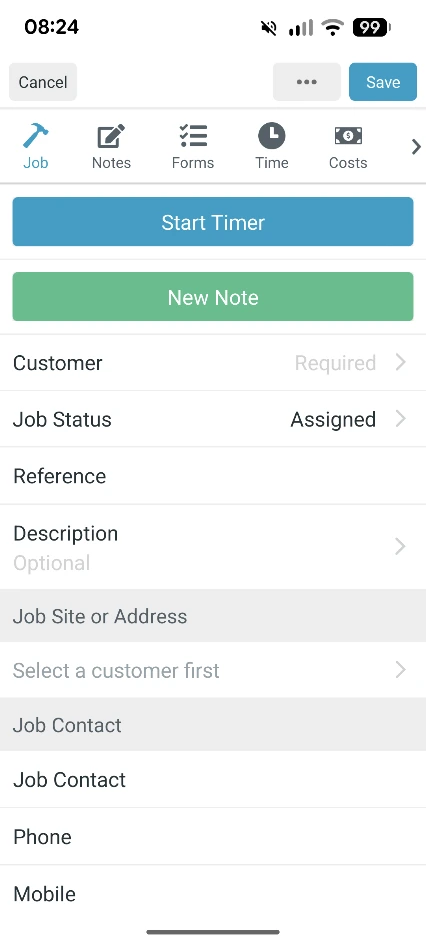
Full Android and iOS apps. This is the one thing Tradify does better than ServiceM8. Both mobile platforms get full-featured native apps, not a webview retrofit. If your crew runs Samsung phones, this alone is enough reason to pick Tradify.
The Xero, MYOB and QuickBooks Online sync is reliable. All three big Australian accounting platforms supported with two-way sync. Invoices, contacts, and payments push through cleanly. The MYOB integration in particular is smoother than several competing platforms I've tested.
Quoting is fast and the templates work. Job templates, kit-based quoting, and importable supplier price lists make repeat quoting quick. Electricians doing similar fit-outs week after week, or plumbers running standardised hot-water-replacement jobs, will save real time here.
Customer support is responsive. Free onboarding calls during the trial, useful written documentation, and email and chat support that answers questions in reasonable time. This is one of Tradify's stronger points and is borne out in user reviews across Capterra and GetApp.
SmartTools (AI features) on the Plus plan are useful. AI-assisted quoting, bill scanning ("SmartRead"), and cost tracking. Helpful for repeat-quote workflows. At $62 a user vs. $52 for Pro, the $10 uplift is justifiable for businesses doing significant repeat quoting. For trades doing one-off jobs, Pro is the better-value tier.
Free Tool
Compare Tradify cost vs ServiceM8 vs simPRO
The "right" job management software depends as much on team size as on features. Per-user vs per-job pricing models lead to wildly different monthly bills. See the comparison.
Try the calculator →Where Tradify falls down
Per-user pricing punishes growth, and this is the main reason most growing trade businesses eventually switch to ServiceM8. A 4-person electrical crew on Tradify Pro pays $208 a month. The same crew on ServiceM8 Growing pays $79 a month, for unlimited users. By 6 staff, you're at $312 on Tradify Pro vs. $79 to $149 on ServiceM8 depending on job volume. The pricing model only really makes sense for solo operators and 2-person teams.
User feedback echoes this. Multiple Capterra reviewers have flagged that Tradify costs roughly double ServiceM8 for similar functionality, and the gap widens as the team grows.
Reporting and analytics are basic. Out-of-the-box reports cover the essentials: job profitability, outstanding invoices, staff time. Anything resembling proper management dashboards or BI requires exporting to Excel. For a sole trader this is a non-issue. For a 10-person business, it's frustrating.
Inventory management is weak. You can track basic materials usage, but Tradify isn't built for proper stock control. No real-time supplier integrations, no van stock management, no automated reordering. AroFlo and simPRO are dramatically stronger here. For trades where materials are a major cost line (HVAC, refrigeration, builders), this matters.
Live supplier price sync is missing. Material prices in Tradify need to be updated manually via CSV imports, or via built-in supplier integrations that don't cover the major Australian wholesalers (Reece, Tradelink, Coventry, Beacon Lighting). In a 2026 market where timber, steel and electrical pricing fluctuates monthly, manual price updates are real friction.
The mobile app can struggle in poor reception. Tradify is cloud-first with limited offline capability. In rural areas, basements, or new sub-divisions where mobile signal drops out, the app slows down or fails to sync. Some tradies report writing things on paper and entering them later, which defeats the purpose. ServiceM8's offline mode is meaningfully better here.
Pricing has crept up. Like most software in the trade space, Tradify's per-user prices have risen steadily over the past three years. Lock-in matters. Switching costs (data migration, retraining staff) are real, so pick the right platform first time rather than assuming you can switch later if pricing gets worse.
Who Tradify is right for
Sole traders, mostly. At $48 a month for one user, Tradify is competitive with ServiceM8's Starter plan ($29 a month, 50-job limit). If you regularly do more than 50 jobs a month, Tradify becomes the cheaper option for solo operators. If you do less, ServiceM8 wins on price.
Two-person crews are still in the running. Two users on Tradify Lite is $96. Two users on ServiceM8 Growing is $79 for unlimited users. ServiceM8 is still cheaper, but the margin is small enough that ease of use can swing the decision toward Tradify.
Crews running Android phones, with a caveat. This used to be the strongest argument for Tradify over ServiceM8, because ServiceM8 had no full native Android app. Its September 2026 release changed that, and ServiceM8's help centre now says its Android app does almost everything the iOS one does. Tradify's Android app has been around longer, and we have not tested ServiceM8's new one side by side yet, so treat Android as a tiebreaker rather than the deciding factor.
Tradies who tried ServiceM8 and found it too dense. Tradify is a simpler, more linear interface. If ServiceM8's feature breadth feels like overhead, Tradify's pared-back workflow is easier to live with day to day.
Trade businesses primarily doing scheduled (rather than emergency callout) work. Tradify's strength is structured job workflows: quote, schedule, execute, invoice. Emergency or callout-heavy work where you're constantly creating jobs in the field is better served by ServiceM8's faster job-creation flow.
Who should pick something else
Pick ServiceM8 if you have 3+ field staff (per-job pricing wins decisively), your team uses iPhones across the board, compliance forms and certificates are central to your work, or you want stronger offline support for poor-reception job sites.
Pick simPRO if you're running 20+ field staff, you need genuine project-based job costing for commercial work, inventory and supplier integration are critical, or you want a vendor with hands-on Australian implementation support.
Pick AroFlo if inventory and material costs are a major pain point, you want real-time integration with Reece, Tradelink, Coventry, or Australian-built and Australian-supported is a priority.
Pick Fergus if most of your crew only need to log hours (Fergus sells timesheet-only users from $26 a month, cheaper than a full seat), or you run staged project work that needs job phases and purchase orders, and New Zealand support isn't a dealbreaker. Our Tradify vs Fergus comparison works through the seat maths.
For deeper comparisons, see ServiceM8 vs Tradify and our roundup of the best job management software for Australian tradies.
Common questions
Is Tradify worth the cost?
For sole traders and very small crews, yes. The admin time saved on quoting, invoicing, and scheduling pays for the subscription within the first month. For teams of 4 or more, the per-user pricing makes ServiceM8 dramatically cheaper for similar functionality, and the value proposition gets weaker as the team grows.
Does Tradify integrate with Xero, MYOB and QuickBooks?
Yes, all three Australian accounting platforms are supported with two-way sync. Invoices, contacts, items and payments flow between Tradify and your accounting software. Setup takes 10 to 15 minutes.
Does Tradify have an Android app?
Yes, with full native functionality. ServiceM8 now has a native Android app too (since ServiceM8 15 in September 2026), so this is no longer a point of difference.
Is there a free trial?
Yes. 14 days, all features included, no credit card required. Worth using the trial to test the workflow with a couple of real jobs before committing.
How does Tradify pricing compare to ServiceM8?
Tradify charges per user per month. ServiceM8 charges per job volume with unlimited users. For a sole trader doing 50+ jobs a month, Tradify is competitive on price. For any crew of 3 or more, ServiceM8 is significantly cheaper for similar functionality. The pricing models cross over around the 2-user mark.
Is Tradify made in Australia?
No. Tradify originated in New Zealand and is now part of the UK-based Access Group. It's localised for Australia (AUD pricing, GST, Australian phone support) but it isn't Australian-built. ServiceM8, simPRO and AroFlo are the Australian-built alternatives.
Can Tradify handle compliance forms (CES, COES, gas safety certificates)?
Tradify supports forms and certificates on the Pro and Plus plans, but the form builder is less mature than ServiceM8's. If compliance documentation is central to your work (solar, electrical, gas), ServiceM8 is the stronger pick.
The verdict
Tradify is the right pick if you're a sole trader, a 2-person crew, or a small team that values a simple interface over feature depth. The interface is the easiest of the major job management platforms to onboard. The accounting integrations work. The mobile app is solid on both iOS and Android.
It's the wrong pick if you have 4 or more field staff. The per-user pricing adds up faster than most tradies expect, and ServiceM8's job-based pricing becomes dramatically cheaper at that scale for comparable functionality. Do the actual maths on your team size before you commit. The difference between Tradify and ServiceM8 for a 6-person crew is over $2,500 a year.
The 14-day free trial is worth using. Every feature is unlocked, no credit card required. Test it on real jobs, not just a demo.
See your real monthly cost
Tradify plus Xero plus payroll plus add-ons. Software costs stack quickly. See the combined monthly figure for your business size before committing.
Try the cost calculator →Try Tradify free for 14 days →
Start Free
Try Tradify free for 14 days
No credit card required. Full feature access during the trial - cancel anytime.
Start your free 14 days →StackPick may earn a commission if you subscribe to Tradify or ServiceM8 through our links, at no extra cost to you. Prices verified from official AU vendor sites. See how we review and our affiliate disclosure.
